

For homeless services organizations and hospital partners
Hospital referrals deserve a confirmed handoff.
A closed loop referral for homeless services makes a hospital referral handoff complete only when the receiving organization confirms the referral and the person’s arrival or next step is documented. It keeps the handoff visible after discharge, so hospital and community partners can see whether it was received, accepted, completed, or blocked.
Sent
An authorized discharge or community referral is initiated.
Received
The next organization acknowledges it. That does not complete the handoff.
Arrived
Arrival with the named community partner is confirmed.
The pilot has not launched. GATEHOUSE, our community platform, where Pathfinders for Hope does your intake, barrier review and the calls to agencies, is open now: register on GATEHOUSE. Recruiting for it has.
The failure point
A referral is marked complete the moment it is sent — never when the person actually arrives.
The record ends here
100
Referrals sent
Every one of them arrived.
100
Referrals sent
Not one of them arrived.
Identical in every report
Logged
The send
A discharge planner sends the referral and closes the task. On their screen the work is finished. The person is still standing in the lobby holding a piece of paper.
No record
The silence
If they never walk through the next door, nothing comes back. No alert, no flag, no follow-up — because no field exists anywhere to hold the answer.
No record
The consequence
The same person surfaces weeks later, further behind than before. Nobody can point to where the handoff broke, so nobody can fix it.
Referral accountability for homeless services
How a closed loop referral can keep a hospital referral handoff from ending in silence.
20
designed case statuses in one state machine
A system requirement keeps every case in a defined status so an unresolved handoff stays visible.
12
planned barrier codes
The pilot design records the reason a person is stuck in a consistent, countable form.
2 hrs
target for routing an intake without ID to a resource
This is a pilot workflow target, not a published outcome. Identity recovery becomes the next action instead of a reason to abandon the referral.
90 days
planned follow-up point for verifying a handoff
The pilot design checks whether the connection held, not only whether the referral was sent.
7 yrs
planned minimum record-retention rule
The software design preserves corrections as new entries instead of erasing the original record.
2
required reviewers plus one documented basis for a denial
This is a system design rule intended to prevent a single unsupported decision from ending the handoff.
For homeless services organizations and hospital partners
What accountable homeless services referrals require
A clear record of whether the referral reached homeless services.
The proposed model separates a referral that was sent from one that was received, accepted, and confirmed at arrival. That distinction gives homeless services organizations and their hospital partners a shared way to review where an authorized transition paused.
A reviewable record for every partner.
Hospital and community teams can retain their own systems and workflows. The proposed layer focuses on the external handoff status, named next action, and documented reason when a referral cannot move forward.
A way to keep uncertainty from becoming abandonment.
A missed call, a full program, a changed phone number, or an intake barrier should not look like a completed referral. The proposed workflow keeps the handoff open until a defined state is documented.
Boundaries that respect each organization’s role.
Operation Iron Gate is a limited referral-confirmation layer. Local housing intake and assessment, EHR and HMIS records, clinical decisions, and discharge responsibilities remain with the organizations that control them. Any future pilot partner keeps control of its own policies, records, consent process, and service decisions.
The proposed workflow
What a hospital-to-homeless services pilot would test
A proposed North Bay Pilot would test whether hospital and homeless services partners can build a verifiable referral record — without replacing hospital systems, HMIS, or local housing intake and assessment.
Every partner keeps its own privacy, consent, EHR, HMIS and reporting obligations. The model covers one authorized cross-organization handoff and uses only the information a participating workflow permits. Participating organizations remain responsible for following their applicable privacy requirements. Read HHS privacy guidance.
01
Sent
The sending team hands off an authorized referral. A discharge planner, with the person’s authorization, connects them to a community provider.
Sending side
02
Confirmed
The receiving organization confirms the referral reached it and the person reached the next step.
Receiving side
03
Known outcome
The handoff ends in a confirmed connection, a documented denial, or active follow-up. Never in silence.
Outcome
Sent is not the same as served.
The only three exits
When a referral cannot move forward
A program is full. A person chooses another path. An intake requires a different eligibility step. These are real outcomes, and each one has a name. A referral that is received but cannot proceed stays reviewable — the record stays open until the team documents one of three things.
A denial reason
Why it cannot proceed, recorded plainly so the next team has an honest basis for another option.
A named next action
What happens instead, and which organization owns it.
Another defined state
The referral moves to another option — never to nothing.
Silence is never recorded as success.
What this model does not control
- Service decisions stay with providers. A referral begins an authorized handoff, nothing more.
- Housing, clinical care, benefits, and eligibility are not guaranteed.
- Local systems retain their roles. Hospital EHRs, HMIS records, and local housing intake and assessment remain under the organizations that control them.
- Records stay with each organization. No partner is asked to pool its records.
- Review is limited. Accountability occurs between organizations, and partners decide what may be used and who may see it.
- The model is still proposed. No hospital partner is described as using it unless that participation is confirmed.
Where the record stops
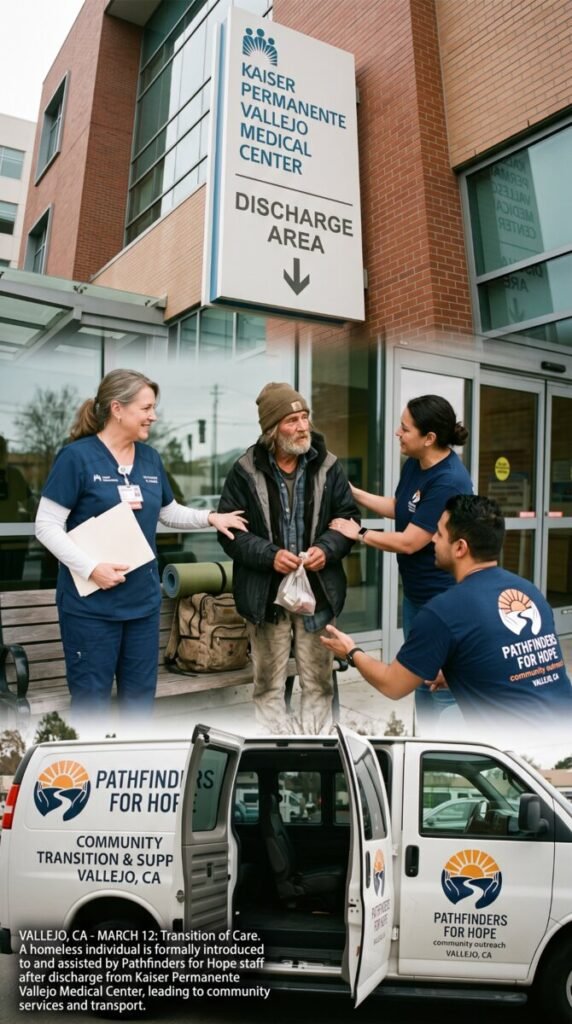
One door out. No record of the next one.
A discharge area is the last place a sending organization can see a person. Everything that matters happens after this doorway — which is exactly why none of it is captured today.
Record state at this doorway
The one question
Every state, every code and every rule in this model exists to answer one thing.
Did the person arrive?
Precisely: after an authorized referral leaves one organization, did the person reach the next agreed step — and if not, why?
> did the person arrive
0 results
The record ends at sent. Nothing after it was ever written, so there is nothing to return — not an arrival, not a refusal, not a reason.
That is the only thing this pilot proposes to change.
Hospital care coordination covers clinical decisions, patient preferences, and many responsibilities that belong to care teams. This model addresses that one narrow question — and nothing else.
Built to sit beside existing systems
It does not replace a hospital EHR, HMIS, or discharge process.
The proposed model is limited to the handoff status that can disappear between organizations.
The sending organization
Hospital EHR
The clinical record, discharge planning, and every care decision that belongs to the care team.
Unchanged · stays yours
The authorized handoff
The only thing Operation Iron Gate records — and the only place a person is currently lost.
The receiving organization
HMIS & local housing intake and assessment
The system of record, intake rules, eligibility, and the decision about whether to accept a referral.
Unchanged · stays yours
Hospitals and community organizations maintain their own systems, workflows, privacy obligations, and reporting rules. Operation Iron Gate is proposed as a narrow coordination and evidence layer for the external referral handoff. It does not claim to be an EHR, HMIS, clinical record, or substitute for discharge planning.
The Agency for Healthcare Research and Quality identifies transitions of care, accountability, follow-up, and links to community resources as care-coordination activities. This proposed model applies those ideas to an authorized hospital-to-community referral while leaving service and clinical decisions with the organizations responsible for them. Read AHRQ’s care coordination overview.
Who joins
Built for the people who own homeless services handoffs
Sends
Starts an authorized referral and records that it left — then finds out whether the person arrived, which is the part that does not exist today.
- Hospital discharge teams
- Emergency departments
Receives
Confirms the referral was seen, accepts or declines on its own criteria, and names a reason instead of letting it go quiet.
- Homeless-service providers
- Behavioral health partners
Reviews
Sees where handoffs hold and where they break across every partner — counted the same way, in the same codes.
- Continuum of Care leads
- City and county human-services teams
A proposed pilot conversation
What a hospital-to-community pilot would involve
-
01
Map the handoff
Identify one authorized referral route from discharge planning to a community organization, and define what each status means before anything is built.
What you walk away with
- One named referral route, end to end
- A plain-language rule for each of the six statuses
- Agreement on what counts as an arrival
- The barrier codes that apply to your intake
-
02
Write the boundaries
Both organizations set the limits in writing — who does what, what may be shared, and which systems stay the system of record.
What you walk away with
- Roles, named on both sides
- The consent practice you already use
- Data boundaries — what is shared, what never is
- An escalation path when a handoff stalls
- Your systems of record, confirmed unchanged
-
03
Decide together
Participation is voluntary. Nothing is deployed, and no partnership is claimed, until an organization agrees to a clearly bounded pilot.
Either outcome is a real outcome
- A bounded pilot scope both sides signed
- Or a no — with the map and boundaries still yours to keep
Straight answers
Common questions
Clear answers for homeless services organizations and hospital partners considering this proposed referral-accountability model.
The honest tally
05
answers are no
01
answer is yes
Not used by a hospital yet. Not an EHR or a discharge process. Not a government program. No published field results. No transfer of responsibility. The one yes: a conversation carries no obligation.
Five of these six answers are no. That is deliberate.
Is Operation Iron Gate already used by a hospital system?
No. There is no hospital deployment or hospital partnership to claim. The North Bay Pilot is being prepared to test the model with organizations that choose to participate.
Does this replace a hospital EHR or discharge process?
No. Operation Iron Gate is not an EHR, HMIS, clinical record, or discharge department. A future participant retains its own system of record, policies, consent process, and service decisions.
Can we have a conversation without committing to anything?
Yes. An initial conversation about the North Bay Pilot carries no obligation to participate, and an organization can stop at any point.
Is this a government program?
No. Pathfinders for Hope is a nonprofit organization. The pilot is not a government program and does not claim government endorsement.
Are there published field results?
No. The pilot has not launched, so there are no field results to report. Any future measurements must be identified as pilot measurements, not as established outcomes.
Does a referral transfer responsibility?
No. Each organization remains responsible for its own services and relationship with the person served. The proposed model records the status of a handoff. It does not transfer clinical, service, housing, benefits, or case-management responsibility.
Next step
Bring your whole organization in.
If your organization sends or receives referrals in Vallejo, the pilot is open to talk to you now — before anything is built around you.