
The initiating organization records that an authorized referral left its workflow.
Operation Iron Gate · Proposed North Bay Pilot
Referral Management Software for Homeless Services Organizations
A referral should not disappear the moment it is sent. This page explains the proposed referral management software approach Pathfinders for Hope is preparing to test with organizations: an authorized handoff remains visible until the receiving organization records what happened next at the agreed step.
The receiving organization records when it can actually view the referral.
The record distinguishes a sent referral from a confirmed next step or documented barrier.
The question
What would referral tracking make easier to review?
Organizations often need a clearer record of what happens after one organization sends a person to another. The proposed pilot would make the handoff status, next action, and any documented barrier easier for participating organizations to review within their own agreed workflow.
- Whether an authorized referral was received.
- Whether the person reached the named next step.
- What action remains when a handoff cannot move forward.
Clear boundary
This is a proposed handoff layer, not a replacement for an organization’s systems.
Each participating organization keeps control of its own policies, records, consent practices, and service decisions. The North Bay Pilot has not launched, and Pathfinders for Hope is recruiting organizations for a bounded pilot conversation. GATEHOUSE, our community platform, where Pathfinders for Hope does your intake, barrier review and the calls to agencies, is open now: register on GATEHOUSE.
Learn more
Explore the referral-accountability framework.
Read moreHow referral tracking would work in a proposed pilot
How it would work
How referral tracking for homeless services would work in a proposed pilot
Referral tracking for homeless services begins with a narrow question: after an authorized referral leaves one organization, what happened at the next agreed step? A sending organization may know it made the referral. A receiving organization may have its own records. The gap appears when nobody has a clear way to confirm whether the handoff was received, whether the person reached the next step, or what action remains if the route cannot continue.
The proposed Operation Iron Gate North Bay Pilot would examine one referral route at a time with organizations that choose to participate. Participants would define the route, the consent practice already used in that route, the meaning of each status, and when an unresolved handoff should be reviewed. The work is about making a limited transition visible. It is not a claim that a referral is complete simply because it was sent.
The difference
A record of activity is not proof of a completed handoff
A referral can be sent and still leave important questions unanswered. Was it received by the named organization? Was the person able to reach the next step? Did the organization have capacity or eligibility to proceed? If not, was there a documented next action? Referral tracking for homeless services is useful when it helps organizations separate those facts instead of treating them as the same event.
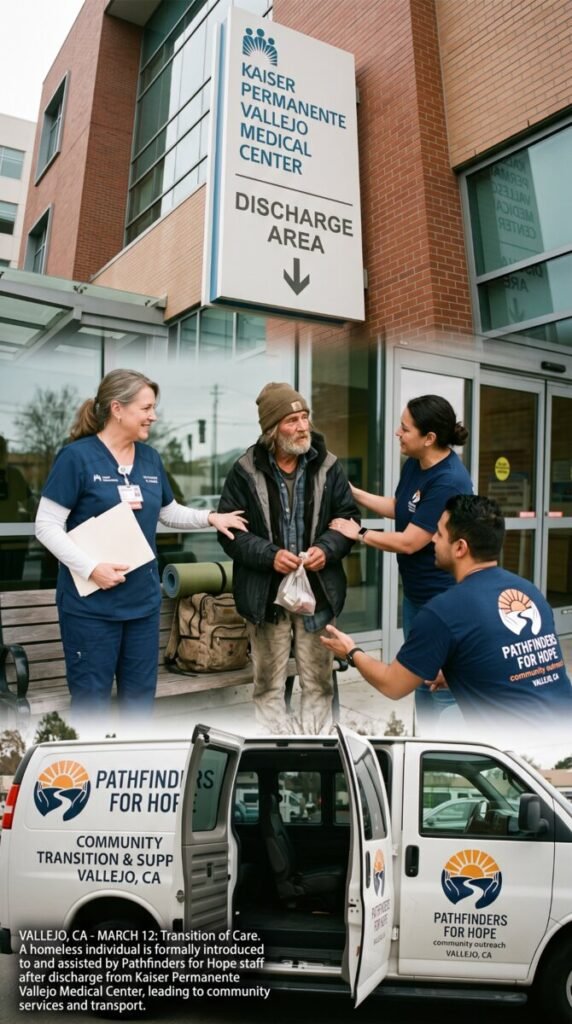
This matters when people move between organizations with different responsibilities. A hospital team, nonprofit, recovery provider, county social-services office, domestic-violence organization, or other community partner may each have its own role. A proposed handoff record does not transfer that responsibility. It simply makes the status of an authorized transition easier to review with the organizations involved.
A useful record distinguishes a handoff that was sent from one that was received. It distinguishes receipt from arrival. It distinguishes arrival from a service decision. It also leaves room for a real barrier: a program may be full, the person may choose a different route, or an eligibility step may need attention. Those facts should lead to a named next action rather than silence.
Cross-organizational tracking
How can organizations track referrals between organizations?
Referral tracking for homeless services can connect nonprofits, healthcare providers, government agencies, and community organizations through a minimum shared handoff record: the destination, the information authorized for the referral, confirmation from the receiving side, the current status, the next owner, the next review date, and the documented outcome. Each organization keeps control of its client records, policies, and service decisions.
What confirms that a person actually connected? A received status is not enough. Connection requires an authorized update from the receiving organization showing that the agreed step occurred, or a documented reason and next owner when it did not.
Pathfinders for Hope is developing the Operation Iron Gate North Bay Pilot around this narrow accountability layer. The goal is to make the handoff visible without duplicating an organization’s complete record. Review the referral confirmation status guide and the platform evaluation checklist. To see how this approach differs from Unite Us and findhelp, read the Unite Us vs. findhelp vs. Operation Iron Gate comparison.
A bounded design
What participating organizations would decide together
- The referral route. One defined handoff from a sending organization to a named receiving organization.
- The status language. Clear terms for sent, received, accepted when applicable, arrival, and a documented barrier or next action.
- The consent boundary. Information used must fit the organizations’ authorized workflow and privacy practices.
- The follow-up point. A practical rule for when an unresolved handoff must be reviewed rather than silently closed.
- The ownership of action. Each organization retains responsibility for its own services, decisions, records, and policies.
These choices matter more than a generic dashboard. Referral tracking for homeless services should reflect the real route an organization uses, the barriers it sees, and the limits it must respect. The purpose is not to create a public directory of personal information. It is to make an agreed handoff less likely to disappear between organizations.
Privacy and consent
Privacy, consent, and organizational roles remain with the organizations involved
Pathfinders for Hope is preparing a proposed pilot, not claiming a live deployment. Any future participant keeps control of its own policies, records, privacy obligations, consent process, and service decisions. The proposed model is limited to the status of an authorized handoff. It does not create a shared client record, make service decisions, or guarantee that a program can accept a referral.
Organizations considering a workflow should use their own legal, privacy, and program guidance. The U.S. Department of Health and Human Services publishes privacy guidance for covered entities and professionals, and the Agency for Healthcare Research and Quality describes care coordination as including accountability, follow-up, and links to community resources. Read HHS privacy guidance and read AHRQ’s care-coordination overview.
What this page does not claim
Referral tracking for homeless services is not a promise of a service or outcome
A referral may begin a conversation, but it does not guarantee housing, benefits, clinical care, eligibility, capacity, or a completed outcome. The receiving organization keeps its own criteria and service decisions. The North Bay Pilot has not launched, and Pathfinders for Hope has no pilot results to publish yet. A record can show that a handoff was made, received, paused, redirected, or confirmed at the agreed next step. It cannot substitute for the services, relationships, and decisions that belong to participating organizations.
Questions for organizations
Questions to ask before adopting a referral-tracking workflow
- Which handoff causes the most uncertainty today?
- What information is already authorized to be shared for that route?
- Who can confirm receipt and the agreed next step?
- What should happen when the person cannot move forward?
- How will each organization keep control of its own records and decisions?
These questions turn referral tracking for homeless services into a practical planning exercise rather than a vague promise. They give partners a way to decide whether a bounded North Bay Pilot conversation is useful before anything is built or claimed.
Practical review
Five questions that keep a handoff review grounded
First, what exactly was sent? A referral record should identify the agreed route and the organization expected to receive it. That does not require a public description of a person’s circumstances. It gives the organizations involved a shared reference point for the authorized handoff they are reviewing.
Second, what counts as receipt? Sending an email, fax, message, or record does not automatically show that the receiving organization could view it. Participating organizations can define a practical receipt point that fits their normal workflow. The point is clarity, not a new burden or a promise that every referral will be accepted.
Third, what counts as the agreed next step? For one route, it may be arrival at an appointment. For another, it may be an intake conversation, document review, or a different step chosen by the organization. Referral tracking for homeless services should use terms that partners can actually apply in the real referral route.
Fourth, what happens when the route stops? A full program, a changed phone number, missing documentation, a different choice by the person, or an eligibility issue can interrupt a referral. Those are not all the same outcome. A proposed handoff workflow gives organizations a way to record the barrier and identify a next action when one is appropriate.
Fifth, who owns the next action? Each organization keeps responsibility for its own services and decisions. A sending organization remains responsible for its own relationship and policies. A receiving organization keeps its own criteria. The proposed pilot does not assign a new authority over either organization. It is a practical way to keep a known handoff from becoming invisible.
These questions also protect the integrity of the pilot. They keep the page from claiming results that do not exist and help future participants decide what can be tested honestly. The value is not in declaring success early. The value is in being able to identify what happened, what did not happen, and what should be considered next.
Pilot discipline
Why a limited pilot comes before a broad claim
A careful pilot begins with a small, agreed referral route because the organizations involved can test the language, consent boundary, follow-up point, and record of action against real workflow conditions. If a definition does not work in practice, participants can revise it before expanding the work. This approach protects people, respects organizations’ roles, and keeps Pathfinders for Hope from presenting a design idea as a proven result. Any future outcome data should identify the route studied, the time period, the method used, and the limits of what the data can show.
Evidence standard
How future pilot findings should be reported
If the pilot launches, Pathfinders for Hope should publish only findings that can be clearly described and checked. Each update should name the referral route, the participating organizations when they agree to be named, the period reviewed, the definitions used, and any limits in the information. It should distinguish a confirmed handoff from a service outcome, and a service outcome from a longer-term result. That reporting discipline keeps the work useful to partners and prevents a small pilot from being overstated as proof of a broader system result.