

Pathfinders for Hope · Operation Iron Gate North Bay Pilot
What Happens After a Hospital Refers Someone Experiencing Homelessness?
Hospital homeless referral follow-up needs a named owner, a receiving contact, and an agreed way to confirm the next step. Sending a referral does not establish that a community organization accepted it or that the person reached a service. Clinical discharge decisions remain with the responsible care team.
Separate discharge planning from referral tracking
This guide addresses communication between organizations, not medical advice or a discharge-compliance checklist. Hospitals must use their own clinical, legal, privacy, and discharge policies. Community partners decide what they can provide within their service scope and capacity.
The practical handoff question is narrower: who will check that the intended next contact happened, and what will they do if it did not? Answer that before the sending shift ends. A generic list of phone numbers does not establish that anyone has accepted responsibility for a particular next step.
Before the handoff leaves the hospital team
- Confirm the destination: verify the appropriate program and its current intake route. Distinguish an information line from a program that has agreed to assess a referral.
- Check the communication plan: establish what may be shared, with whom, and through which approved channel. Do not assume a general release covers every recipient or record.
- Make the next step understandable: confirm the person knows whom they are trying to reach and what is expected. Use the organization’s accessibility and language-support processes.
- Assign a follow-up role: identify the sending team’s role and the backup when that worker is unavailable.
- Check practical arrangements: where relevant, ask the responsible team to confirm appointment instructions, timing, and transport arrangements rather than treating them as settled by the referral itself.
Agree on a limited, useful return message
A receiving partner may be able to acknowledge the request, ask for an authorized clarification, confirm an assessment appointment, or report that it cannot proceed. Those messages are different from a clinical record or a full explanation of the person’s situation. Exchange only information allowed by the applicable permissions and organizational rules.
Keep “appointment scheduled,” “arrival confirmed,” and “service started” distinct. If the organization cannot obtain an authorized outcome, use an explicit unknown status. Do not fill the gap with an assumption of either success or failure.
Handle a failed connection without creating a dead end
Choose an escalation route in advance. A wrong destination, closed intake window, unavailable capacity, and an unreachable person each need a different response. Record the barrier at the level needed for the next authorized action, then give that action to a named team or role.
If a need becomes urgent, follow established clinical or emergency procedures. This guide does not establish a safe waiting period, authorize a discharge, or promise accommodation. Organizations should not rely on the Operation Iron Gate pilot as an open public intake service.
Example: an assessment is not a placement
Hypothetical planning example: a hospital team requests a community assessment. The partner offers an appointment but has not determined program eligibility. The sender records “assessment scheduled,” confirms the agreed instructions, and identifies who will check the authorized result. Reporting this as a housing placement would overstate what the handoff achieved.
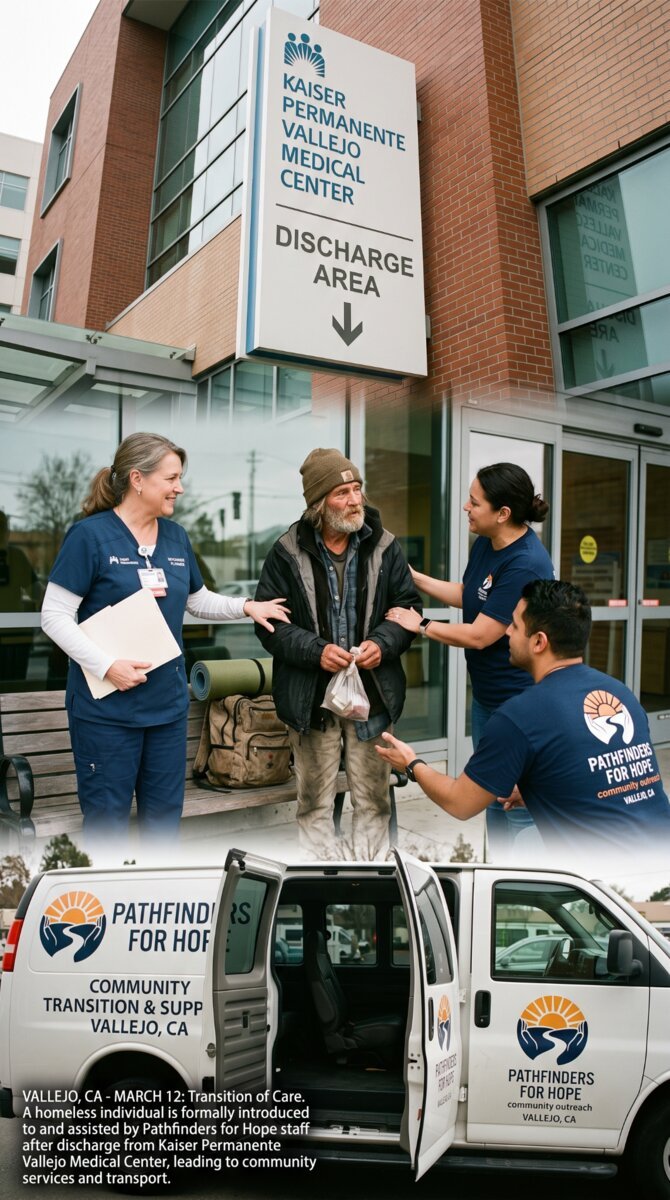
Seven hospital homeless referral follow-up steps
A reliable hospital homeless referral follow-up process separates clinical discharge responsibilities from the limited communication needed to track a community handoff. The steps below are planning questions for hospitals and participating organizations. They do not authorize a discharge, determine eligibility, or promise that a service is available.
1. Define the exact purpose of the referral
Write the requested next step in plain language. Is the hospital requesting an information call, a program screening, an assessment, transportation coordination, or another clearly defined action? A vague request to “help with homelessness” does not tell the receiving organization what response is needed. The person should understand the intended contact and any choices that remain theirs.
2. Verify the current destination
Confirm that the organization handles the request type and that the contact route is current. A public information line may not be the same as a referral channel, and a referral channel does not guarantee acceptance. Record the program or role contacted, the date, and the method approved by the participating organizations. This small check prevents avoidable delays caused by old email addresses, closed intake windows, or a mismatch in service scope.
3. Confirm permission and communication limits
Use the hospital’s policies and applicable law to determine what may be shared, with whom, and for what purpose. Share only the information needed for the authorized next step. Confirm whether voicemail, text, email, a portal, or another method is appropriate for the person and the organizations. The U.S. Department of Health and Human Services guidance on permitted disclosures provides federal background, but each organization remains responsible for its own privacy review and procedures.
4. Name the sending owner and backup
The hospital team should identify the role that will check for a response and the backup when that person is unavailable. Ownership should survive shift changes, weekends, and leave. A shared, approved work queue can support continuity when it does not expose information beyond authorized staff. Hospital homeless referral follow-up should never depend only on one worker remembering to make a call.
5. Ask for a limited receipt response
Agree on what the receiving organization can return. Useful responses may include received, needs authorized clarification, unable to review, wrong destination, or assessment offered. Acknowledgment is not acceptance, and acceptance is not a completed service. Preserve those distinctions in the record so a dashboard does not overstate what happened.
6. Check the next milestone
Define the next milestone and its reporting window. Examples include an appointment offered, an assessment attended, or a service started. State who may verify it and how unknown outcomes are recorded. A responsible hospital homeless referral follow-up record shows pending and unknown results alongside confirmed ones. It does not convert silence into success or failure.
7. Use the agreed escalation route
Plan what happens when the destination is wrong, capacity is unavailable, information is missing, or the person cannot be reached through the agreed method. Each barrier calls for a different response. The next action may be clarification, a discussion of another option, a clinical review, or use of an established urgent-response procedure. The pilot is not an emergency service or public intake pathway; call 911 for an immediate life-threatening emergency and register on GATEHOUSE for local resource navigation where appropriate.
Hospital follow-up record: minimum useful fields
- Referral purpose: the precise next contact requested.
- Destination: the participating organization, program, or role contacted.
- Permission basis: where the sending organization records it under its own procedures.
- Sent date and channel: the approved method and time of transmission.
- Owner and backup: the roles responsible for checking the next step.
- Receipt status: received, clarification needed, unable to review, or still unanswered.
- Milestone status: offered, scheduled, attended, started, pending, declined, or unknown as defined locally.
- Next review date: the agreed point for another authorized check.
These fields are not a universal medical record or a substitute for an organization’s required documentation. Their purpose is to support a limited, accountable handoff. Partners should decide where each item belongs, who can view it, how long it is retained, and when it must be corrected or closed.
Questions for a hospital-partner working session
Before launching any hospital homeless referral follow-up workflow, ask: Which referral types are in scope? Who can acknowledge receipt? What message can the receiver safely return? What is the expected response window? Who owns the next check on nights and weekends? How are wrong destinations corrected? How are person-directed choices recorded? Which measures may be reported in aggregate, and who reviews privacy risk?
Document answers as a versioned operating agreement. Test the process with fictional scenarios before using it. Review a small sample after launch to see whether roles, channels, and status definitions remain understandable. If the workflow changes, update training and measurement rules at the same time.
What this process can and cannot show
Hospital homeless referral follow-up can show whether the participating teams exchanged an authorized response and whether a defined next milestone was verified. It cannot by itself prove that a person obtained housing, that the discharge was clinically appropriate, or that one organization caused a longer-term outcome. Report each measure with its numerator, denominator, reporting cutoff, pending count, and limitations.
For broader local planning, review HUD’s Continuum of Care program information. Local requirements, hospital policy, participating-provider capacity, and the person’s choices control the actual process.
Related guidance and source
Use the hospital referral handoff overview for the pilot context and the receipt-confirmation guide for status definitions.
AHRQ’s Integration Academy discusses coordination and referral follow-up in opioid-use-disorder care. That healthcare guidance informs the communication principle here; the proposed planning steps above are not a substitute for hospital policy. Read the AHRQ care-coordination resource.
Frequently asked question
Who owns follow-up after a hospital referral?
The sending and receiving organizations should agree on a responsible role and backup for each next step. A referral sent or an appointment scheduled does not by itself transfer every responsibility or establish that a service was delivered.
For the underlying standard, see referral accountability. For the patterns behind lost hospital handoffs, see why referrals fail between organizations.
Operation Iron Gate North Bay Pilot
Pathfinders for Hope is developing the pilot with organizational partners. Pathfinders for Hope intake is open by phone at (707) 205-7588, and no service or placement is guaranteed. GATEHOUSE, our community platform, where Pathfinders for Hope does your intake, barrier review and the calls to agencies, is open now: register on GATEHOUSE. Discuss the pilot with Pathfinders for Hope or browse the resource hub.
Prepared by Pathfinders for Hope. Updated September 5, 2026. Resource scope and sources.
The working room
Don’t fix referrals alone.
GATEHOUSE is where the agencies, hospitals, churches and neighbors working on referrals in Vallejo and Solano County talk it through. It is the part of Operation Iron Gate that is open today, and what members say decides what we build next.
Already a member? Log in
GATEHOUSEMember pass
OPEN NOW- Put your agency on the mapList your organization and post what you have open for Tonight.
- Ask the teamOpen Q&A with our team and peers who work the same handoffs.
- Report a dead endLog a referral that went nowhere and follow it to a fix.
- Follow the pilotPilot Updates as the North Bay Pilot is built. No results are claimed.